


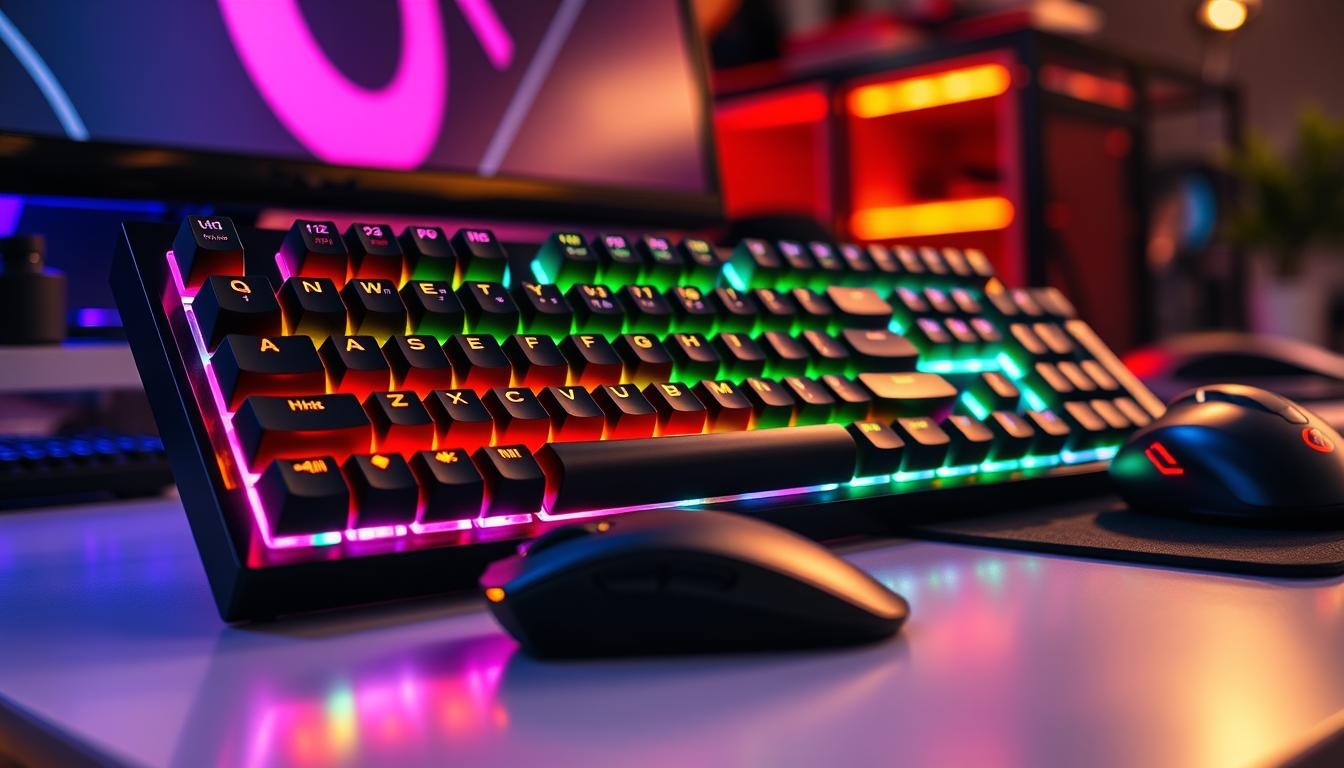
One study found that switching to a better input device can cut miss-clicks by up to 30% — a simple change that often yields bigger gains than upgrading a GPU. We introduce our product roundup focused on the top RGB keyboard for gaming options available in the United States.
We explain how we evaluate build quality, responsiveness, features, and value across different desks and playstyles. Per-key lighting matters: it helps with layer cues, macro mapping, and scene sync with stream setups.
Our selection criteria cover switch feel and reliability, low-latency input on wired and wireless modes, polished software, and ergonomic layout and media controls. We also outline why a new mechanical keyboard can improve both play and typing when you match the right switch type and size to your needs.
Finally, we preview categories we test — from full-size to mini, budget to magnetic switch options — and how we balance latency, comfort, acoustics, and long-session endurance so each pick serves a real user.
Key Takeaways
- We test build, latency, software, and ergonomics to recommend suitable options.
- Per-key lighting helps with macros, layers, and streaming integration.
- Choosing the right switches and layout impacts both play and typing.
- We cover wired and wireless choices across several size categories.
- Our picks balance performance, comfort, and value for real US setups.
What gamers in the United States want right now from a top RGB keyboard for gaming
US players want instant, predictable input that feels the same match after match. We look for stable firmware, crisp switches, and reliable debounce and scan behavior so every press registers the way you expect.
Compact layouts that free up space for your mouse are in demand, but many still choose full-size boards when they need a numpad and media keys. Vibrant rgb with per-key control remains a must, as long as lighting doesn’t add latency or force constant app dependence.
Hot-swap PCBs let us change switches without buying a new unit, improving acoustics and the feel of typing and play. Low-latency 2.4 GHz wireless now rivals wired input, so battery life and quick wake behavior matter for couch setups.
- On-board profiles to store macros and lighting
- Durable double-shot PBT keycaps, tuned stabilizers, and aluminum plates
- Quality-of-life controls like rollers or dials for streaming and music
We test these priorities in real setups and link readers to our broader picks, including the best gaming keyboard guide to help narrow choices.
Editor’s pick: Best overall RGB gaming keyboard right now
We chose a single model that pairs a near‑full set of keys with compact real estate and long wireless life. The Asus ROG Strix Scope II 96 Wireless stands out for players who want both utility and daily comfort.
Asus ROG Strix Scope II 96 Wireless — why it leads
We picked this unit because the 96% layout keeps a numpad without the bulk of a full board. That saves desk space while preserving key access for work and play.
Key specs and layout
- Layout: 96% footprint with per‑key rgb and double‑shot PBT keycaps.
- Connectivity: Tri‑mode (2.4 GHz low‑latency, Bluetooth, USB‑C wired).
- Hardware: Hot‑swappable PCB (3‑ and 5‑pin), aluminum alloy top plate, 2.23 lb build.
- Switches: ROG NX Snow linear (45 g, 1.8 mm) or Storm tactile options.
- Battery: Rated up to 1,500 hours over 2.4 GHz with lighting off.
- Controls: Multi‑function key and clickable roller for volume, media, and lighting.
Pros and cons
Build quality, hot‑swap support, and long battery life are clear strengths. The clickable roller and media controls make in‑game adjustments fast and intuitive.
Trade‑offs include Armoury Crate quirks and only a single programming layer, which limits deep macro stacks. The condensed layout can need a short adjustment for some users.
| Feature | Detail | Why it matters | Notes |
|---|---|---|---|
| Layout | 96% footprint | Saves space while keeping numpad | Good for desk setups |
| Connectivity | 2.4 GHz, Bluetooth, USB‑C | Flexible use cases | Low‑latency option available |
| Switch support | Hot‑swap 3/5‑pin | Easy feel/sound customization | Supports common mechanical switches |
| Materials | Aluminum top, PBT keycaps | Durability and premium feel | Heft improves stability |
Best full‑size RGB gaming keyboard for desk‑bound power users
A full‑size layout gives power users on‑desk access to every control without reaching for extras.

Razer BlackWidow V4 Pro — macros, Command Dial, and 8,000 Hz polling
We recommend the BlackWidow V4 Pro when you want a true command center. It ships as a wired, full‑size unit with per‑key lighting and an underglow system that blends the board’s 18 zones with a plush magnetic wrist rest that adds 20 more zones.
Key features include five left‑side macro keys (M1–M5), three side macro buttons, a programmable Command Dial with up to 100 modes, machined media keys, a textured volume roller, and up to 8,000 Hz polling. All keys are fully programmable through Synapse and support HyperShift and up to five onboard profiles.
Who should choose this model?
This unit suits creators, MMO players, and streamers who rely on many macros and direct media controls. The wired connection helps keep lighting stable and lowers latency on high‑refresh rigs.
Trade‑offs include ABS keycaps, macros disabled by default, and customization tied to the manufacturer’s software. If you prefer a simpler layout or a different knob style, consider the Corsair K70 Max RGB or NZXT Function 2 as alternatives.
| Attribute | Detail | Why it matters | Notes |
|---|---|---|---|
| Macro keys | 5 left + 3 side | Fast access to complex commands | Ideal for MMOs and stream macros |
| Dial & profiles | Command Dial, 100 modes, 5 profiles | Mode switching and layered workflows | Programmable via Synapse |
| Polling & connectivity | 8,000 Hz, wired | Lower input latency on high FPS rigs | Best with stable USB connection |
| Comfort & lighting | Magnetic wrist rest, 38 lighting zones | Comfort and immersive underglow | Wrist rest snaps on/off |
For a deeper comparison of full‑size options and picks that match different budgets, see our guide to the best keyboards.
Best TKL pick for competitive play and typing feel
We picked a TKL that blends low-latency performance with a premium typing profile. The Lemokey L3 aims to satisfy players who split time between fast matches and long typing sessions.
Lemokey L3 — aluminum chassis, hot‑swap, 2.4 GHz at 1,000 Hz
The L3 uses a CNC‑machined 6063 aluminum chassis and weighs 4.36 lb. That heft, plus a double gasket mount, gives a stable base and clear acoustics compared with typical plastic boards.
It ships with hot‑swappable PCB and Gateron Jupiter Red, Brown, or Banana switches. Connectivity covers 2.4 GHz at 1,000 Hz, Bluetooth 5.1, and USB‑C wired. Battery life reaches about ~200 hours with lighting off.
QMK/VIA flexibility vs. gamer‑first software suites
Open firmware is a big part of the L3’s appeal. QMK and VIA support deep remaps, layered layouts, and on‑board macros without cloud logins or background apps.
There’s an extra left‑side macro row and a rotary knob for quick binds. Double‑shot PBT Cherry‑profile keycaps arrive fitted and improve long‑term durability and feel.
What to expect: you gain a refined sound, robust build, and hot‑swap freedom. The trade‑off is size — the L3 is larger than many tenkeyless units, so it’s less portable but more stable on desk setups.
If you want detailed setup tips or a parts list for customizing this model, see our TKL mechanical keyboard guide.
Best mini board for maximum mouse room and per‑key control
When mouse real estate matters most, a compact board that still offers per‑key tuning makes all the difference. The SteelSeries Apex Pro Mini packs advanced actuation tech into a 60% frame so you keep space and control.
SteelSeries Apex Pro Mini — OmniPoint 2.0 HyperMagnetic switches
OmniPoint 2.0 HyperMagnetic switches let us set actuation per key. That includes Rapid Trigger for faster repeats and dual‑actuation so one press depth can trigger distinct actions.
Adjustable actuation, dual‑actuation, Rapid Trigger explained
Firmware widens the actuation range and SteelSeries GG exposes per‑key thresholds. We recommend saving profiles on the board; five on‑board slots cut reliance on desktop apps.
- Size: 293 x 103 x 40.3 mm (60% footprint).
- Build: aluminum top plate, double‑shot PBT keycaps.
- Connectivity: 2.4 GHz, Bluetooth 5.0, USB‑C wired; ~30 hours over 2.4 GHz.
- Notes: GG enables deep remaps but can be buggy; wired version available at lower MSRP.
| Spec | Detail | Why it matters | Practical tip |
|---|---|---|---|
| Switch tech | OmniPoint 2.0 | Adjustable actuation & dual triggers | Tune per key for speed or control |
| Lighting | Per‑key rgb | Visual cues for layers | Use side legends to learn binds |
| Profiles | 5 onboard | Store presets without apps | Save competitive and work profiles |
| Battery | ~30 hours (2.4 GHz) | Plan charging between sessions | Use wired mode for long plays |
Best budget RGB gaming keyboard that doesn’t feel budget
We tested budget contenders to find one that gives premium typing comfort without the premium tag.

Cooler Master MK770 — gasket mount comfort and 96% layout
The MK770 offers a 96% layout and a gasket mount that softens typing and play. Its hot‑swappable 5‑pin PCB accepts Kailh Box V2 Red, Brown, or White switches so you can tweak feel later.
Connectivity is tri‑mode: 2.4 GHz, Bluetooth, and USB‑C. A 4,000 mAh battery gave us roughly one week of use on 2.4 GHz with lighting off.
Where it shines and where the software lags
Per‑key rgb, a volume knob, and double‑shot PBT shine‑through keycaps are practical daily wins. The plastic chassis and single height option for the feet are minor compromises.
- Why buy: gasket comfort, hot‑swap flexibility, compact layout at a friendly price.
- Practical limits: MasterPlus software can be slow and crash‑prone, making remaps and lighting edits tedious.
- Verdict: If you value feel, switch options, and durable keycaps over flawless app polish, the MK770 is a strong budget choice.
Best magnetic switch experience for speed and precision
We tested magnetic actuation across the SteelSeries Apex Pro lineup to measure real gains in speed and control. The OmniPoint 2.0 HyperMagnetic system gives per‑key actuation, Rapid Trigger, and dual‑actuation that few other solutions match.
Why OmniPoint 2.0 stands out
Adjustable actuation lets us set shallow travel on movement and aim keys, while keeping deeper travel on reload or interact to avoid accidents. Rapid Trigger provides instant resets for fast repeats. Dual‑actuation can bind two actions to a single press depth, but it requires practice to use well.
Practical setups: lighter actuation on WASD and aim, deeper on utility keys, Rapid Trigger on tap‑spam binds. We recommend saving tuned profiles to on‑board memory so settings stay tournament‑safe even if the desktop software glitches.
Firmware updates expanded the actuation range, but SteelSeries GG can be finicky. When dialed, the precise switch behavior and subtle rgb cues help us react faster and reduce mispresses across play styles — especially in competitive matches and tight action windows.
Wired vs. wireless: latency, polling rate, and battery life trade‑offs
We weigh wired and wireless trade‑offs by testing latency, polling, and battery in real play sessions.
Wired connections give constant power and can reach very high polling, like the Razer BlackWidow V4 Pro’s 8,000 Hz. That matters on fixed battlestations where max responsiveness and heavy RGB zones are priorities.
Modern 2.4 GHz wireless now hits near‑wired latency in many scenarios. Designs such as the ROG Strix Scope II 96 Wireless can run up to 1,500 hours with lighting off. Still, runtimes vary: Lemokey L3 is roughly 200 hours with lighting off, while compact boards like the Apex Pro Mini trade battery for features and last about 30 hours on 2.4 GHz.
RGB brightness and effects shorten runtime. We favor on‑board lighting controls and a saved low‑power profile so you can dim or toggle mid‑session without software.
Switch feel stays the same across connections, but wake behavior, dongle placement, and RF interference affect perceived responsiveness. Validate polling and latency in software or test tools, and place the dongle clear of metal and USB hubs for best results.
| Connection | Real‑world strength | Battery / runtime | Best use |
|---|---|---|---|
| Wired (USB) | Consistent power, highest polling (up to 8,000 Hz) | Unlimited during use | Desk setups with heavy RGB and peripherals |
| 2.4 GHz wireless | Near‑wired latency, tri‑mode options common | Scope II ~1,500 hrs; L3 ~200 hrs; Apex Mini ~30 hrs (lighting off) | Clean desks, travel, couch play |
| Bluetooth | Multi‑device convenience, higher latency vs 2.4 GHz | Varies widely; often longer but with more lag | Mobile use, casual typing, low‑power needs |
Switch feel decoded: linear, tactile, clicky, and magnetic
Different switch designs change how you press, hear, and trust each input—here’s what matters in play.
Gaming scenarios: fast actuation vs. controlled resets
Linears give smooth travel and fast repeats. They shine in FPS and twitch play where quick actuation wins.
Tactile switches offer a bump for feedback without loud noise. We prefer them for RPGs and mixed work where precision matters.
Clicky switches give audible confirmation. They suit typists or anyone who likes strong sensory feedback and doesn’t mind volume.
Magnetic options let us change actuation per key and enable rapid resets. That flexibility helps with burst skills and complex binds.
Sound and dampening: case foam, plate, and mount matter
Case material, plate stiffness, and mounting style shape feel and sound. Gasket mounting with foam layers softens impact and reduces rattle.
Stabilizer tuning and lubrication matter most on long keys. Properly lubed stabilizers cut noise and improve perceived quality during fast typing and strafes.
Our advice: pair switch type to genre—fast linears or magnetic for FPS, tactile for precision play and typing, and clicky if sound is desirable.
- Tip: acoustic mods (foam, tape, films) can upgrade a modest switch without replacing it.
Keycaps, materials, and durability: PBT vs. ABS and shine‑through RGB
Durable caps and smart material choices shape how a board feels and how long it lasts under heavy use. We focus on materials that resist shine, keep legends crisp, and hold texture through thousands of hours of play and typing.
Double‑shot PBT keycaps resist oil and wear better than ABS. The ROG Strix Scope II 96 Wireless, Lemokey L3, and Apex Pro Mini all ship with double‑shot PBT keycaps or Cherry‑profile PBT that retain texture and sharp legends.
ABS caps can look brighter under lighting but wear faster. The Razer BlackWidow V4 Pro ships with ABS, which emphasizes lighting and lowers cost. That trade‑off can make sense if you prefer strong backlighting over long‑term feel.
Shine‑through options help rgb show clearly, but solid PBT often looks more premium and needs stronger light or side legends for layer cues. Profile matters too: Cherry vs. OEM changes finger travel and long‑session comfort.
- Durability: double‑shot molding keeps legends intact.
- Feel: PBT keeps texture; ABS smooths over time.
- Design tip: prioritize stable stabilizers under larger caps to improve typing and confidence in fast play.
Layouts and sizes: full‑size, 96%, TKL, 65%, 60%—which fits your setup
Choosing the right layout changes how your hands sit, how much desk space you keep, and which shortcuts are immediately available.
Full‑size offers the most keys and dedicated controls, ideal for spreadsheet and MMO power users who need a numpad and media row. The 96% design keeps a numpad in a tighter body—examples include the ROG Strix Scope II 96 and the MK770.
TKL removes the numpad and reclaims mouse room; the Lemokey L3 highlights that trade‑off. A 60% board, like the Apex Pro Mini, maximizes desk space and aim angles but leans on layers and function combos.
We note learning curves when moving to condensed layouts. You rely on layers for navigation and F‑row access. Clear legends and on‑board profiles ease that shift.
- Space trade‑offs: full‑size = most keys; 96% = compact numpad; TKL = extra mouse sweep; 60% = max portability.
- Who picks what: MMO and spreadsheet users lean full‑size or 96%; FPS players often choose TKL or 60%.
Measure desk depth and mouse pad area as a key factor. Try a cardboard cutout to visualize posture and mouse arc before you buy.
Macro keys, media controls, and dials: when extra controls win games
“Dedicated dials and macro banks keep complex commands at your fingertips when the pressure is on.”
We test how added controls change play. The Razer BlackWidow V4 Pro ships with five macro keys, three side macro buttons, and a Command Dial. That hardware reduces travel and keeps hands on core movement.
Hardware macro mapping gives a clear edge in MMOs and MOBAs. Map ping, push‑to‑talk, and clip capture to a spare button so you don’t break aim or combos.
Media handling matters too. A clickable roller or dial lets us tweak volume and stream mixes without alt‑tabbing. That saves seconds and keeps focus.
On‑board layers double shortcut capacity. We color‑code each layer with per‑key lighting to confirm the active set under pressure.
- Why hardware wins: reliable mid‑match and no app switching.
- Best maps: utility binds on macros, movement on main row.
- Tip: test bindings in practice mode before ranked play.
Software ecosystems and on‑board profiles: GG, Synapse, Armoury Crate, QMK/VIA
The software stack behind a board often decides whether advanced features feel like toys or real tools. We evaluate apps and firmware that ship with each product and how reliably they store profiles on the device.
SteelSeries GG shines when per‑key actuation and profile syncing matter, especially on the Apex Pro line. Razer Synapse gives deep macro layers, HyperShift, and multiple dial modes that map to workflows.
Armoury Crate programs rollers and multifunction keys but can demand background services that some users find annoying. For enthusiasts, QMK and VIA offer powerful on‑board remaps and layered layouts without cloud dependency.
Remaps, layers, and per‑key RGB without bloat
Save critical profiles to on‑board memory so remaps, lighting, and controls follow you to any PC. That avoids reinstalling apps under pressure.
- Tip: disable auto‑launch and trim plugins to cut app overhead.
- Check: firmware version notes before events to avoid surprises.
- Note: players eyeing a pro tkl should confirm feature parity and on‑board storage across sizes.
How we test RGB gaming keyboards at present
We put each board through stress routines that expose latency spikes, rattles, and wear over time. Our process blends lab tools and hands‑on trials so results match real play and daily typing.
Input latency, polling validation, and switch consistency
We validate input performance by measuring polling rates and checking stability across long sessions. We log scan behavior and debounce to ensure consistent responsiveness.
Switches get typing tests and timed drills to confirm uniform actuation and to note any stem slack or north‑south wobble.
Build quality, acoustics, and long‑session typing feel
We inspect plate material, case rigidity, and stabilizer tuning. Controlled sound checks reveal ping, hollowness, or thock, and we measure how foams or gaskets change tone.
Long typing sessions rate fatigue, posture comfort, and keycap texture retention. We also test software installs, on‑board profiles, and wireless wake and RF reliability under crowded conditions.
| Test area | Method | Metric | Why it matters |
|---|---|---|---|
| Latency & polling | Tool logs + human timing | ms jitter, poll Hz | Ensures predictable input in play |
| Switch consistency | Typing matrix + drills | Actuation variance, wobble | Uniform feel across the board |
| Acoustics & build | Sound checks, teardown | Ping level, resonance | Comfort and perception of quality |
| Wireless stress | RF interference tests | Wake time, drop rate, battery | Reliability during travel and events |
Other notable gaming keyboards we tested and why they missed the cut
Several solid alternatives impressed in specific areas yet missed the all‑around balance we prize.
Corsair K70 Max RGB brings a handy rotary knob and high polling rates. It still fell short because its macro depth and dial modes are less flexible than some rivals. That limits power users who need layered profiles saved on the device.
NZXT Function 2 nails a clean design with left‑side media keys and a volume roller. We like the minimal approach, but users who want heavy remapping or advanced software features may find it too spare.
HyperX Alloy Origins is a durable, no‑frills full‑size option. It often goes on sale and offers reliable per‑key lighting, yet it lacks extra controls that some streamers and macro users want.
In short, misses usually came down to software maturity, fewer on‑board profiles, or a narrower feature set at a given price. Our winners combined substance in build, switch feel, lighting control, and everyday ergonomics in ways these alternatives did not.
| Model | Highlight | Main shortfall |
|---|---|---|
| Corsair K70 Max RGB | Rotary knob; high polling | Limited macro/dial depth |
| NZXT Function 2 | Clean design; media roller | Light on remapping and software |
| HyperX Alloy Origins | Durable, simple, often discounted | Fewer dedicated controls |
Shopping tips and current deals to time your purchase
Timing a purchase well can save real dollars and get you a better feature set without compromise.
What specs matter most
We recommend prioritizing switch type, hot‑swap support, layout size, and on‑board profiles first. These choices shape feel and daily use more than flashy extras.
Then, weigh software polish, wireless needs, and battery life to match your setup. Verify that your preferred version (wired or wireless) keeps core features intact.
Spotting meaningful discounts and promos
“Retailers often promote dollars‑off deals and bundles during big sale windows,” we note. Check manufacturer stores for stackable coupons and bundled extras like wrist rests or keycap sets.
- Compare prices to stable street rates, not only MSRP.
- Favor real dollars‑off over small percentages on inflated baselines.
- Track major sale periods and brand promos for the best bundles.
Final checks: confirm 2.4 GHz polling and wake times if you need cable‑free play, review return and free‑shipping policies, and budget for switch sets or PBT caps that often improve feel more than minor spec upgrades.
Conclusion
Conclusion — pick the right board, not the flashiest spec.
We match each model to its core strength: the ROG Strix Scope II 96 Wireless for balanced everyday excellence, the BlackWidow V4 Pro for macro‑rich control, the Lemokey L3 for premium TKL feel, the Apex Pro Mini for adjustable actuation in a tiny frame, and the MK770 for value.
Choose by size and layout first, then by switch preference and which keys you need. Next check connectivity, software, and lighting priorities like per‑key rgb and on‑board profile slots.
Try actuation and key feel before you commit. Our tests focus on latency, stability, and comfort, and we recommend saving your best profiles on‑board. Time your purchase to get the right version at the right price.